Navigating KRA Compliance: The Complete Small & Micro Business Tax Guide

Once your business is registered, your next priority is tax compliance. In Kenya, the Kenya Revenue Authority (KRA) manages business taxation through the iTax portal and the eTIMS (electronic Tax Invoice Management System) platform.
Failing to register for the correct tax obligations or missing filing deadlines can lead to heavy penalties, frozen bank accounts, and lost business opportunities (such as disqualification from government or corporate tenders).
This guide breaks down KRA tax obligations, eTIMS invoicing rules, filing deadlines, and how to maintain an active Tax Compliance Certificate (TCC).
1. Choosing Your Tax Regime: Turnover Tax vs. Standard Income Tax
The KRA categorizes small and medium-sized businesses into two main income tax frameworks based on annual turnover.
Annual Gross Turnover Thresholds (Kenya)
Businesses are typically categorized for income tax purposes based on their annual gross turnover (total sales/revenue before deducting any costs).
Where annual gross turnover falls between KES 1,000,000 and KES 25,000,000, the applicable regime is generally Turnover Tax (TOT). This is charged at 1% of gross revenue and is calculated on the total amount earned from sales/services for the year (or relevant period), with no deductions allowed for business expenses such as rent, salaries, utilities, transport, marketing, or cost of goods sold;
For example, a business with KES 10,000,000 in gross revenue would pay KES 100,000 under TOT regardless of whether its operating costs were high.
Where annual gross turnover exceeds KES 25,000,000, the business generally moves to the standard Corporate/Individual Income Tax framework:
Companies are commonly taxed at 30% of net profit (profit after allowable deductions), while individuals are taxed under the applicable individual income tax rules; under this regime, taxpayers can deduct qualifying business expenses and capital allowances (subject to tax rules and documentation), meaning tax is based on profitability rather than sales volume.
For example, a company with KES 40,000,000 in revenue and KES 34,000,000 in allowable expenses would have KES 6,000,000 taxable profit and a corporate tax liability of KES 1,800,000 at 30%.
In all cases, accurate record-keeping (sales invoices, receipts, expense schedules, and bank statements) is essential to support turnover calculations, compliance filings, and any allowable deductions where applicable.
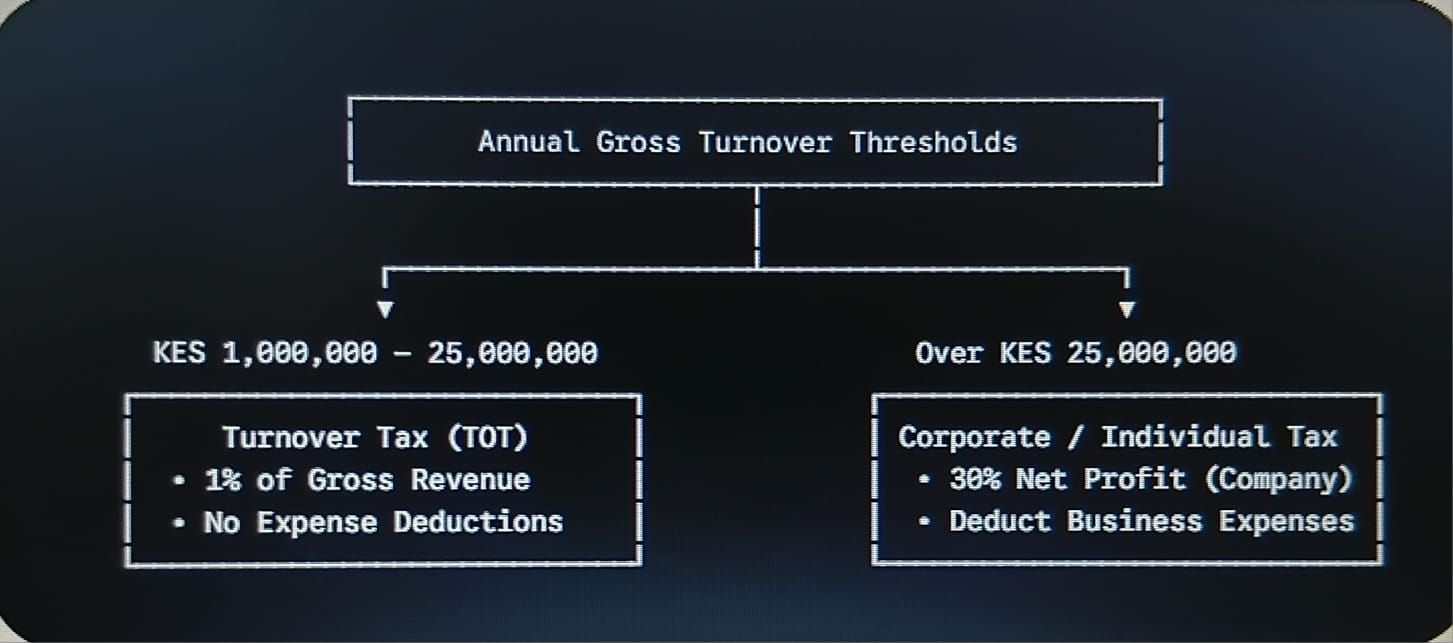
Turnover Tax (TOT)
- Who it’s for: Micro and small businesses earning between KES 1,000,000 and KES 25,000,000 annually.
- The Rate: 1% of gross monthly turnover.
- Key Feature: TOT is a final tax. You do not file separate annual profit/loss taxes on this revenue. However, you cannot deduct business expenses (you pay 1% on total revenue, regardless of profit or loss).
- Exclusions: Rental income, professional/management consultancy fees, and companies earning over KES 25 million.
Standard Corporate Income Tax / Individual Income Tax
- Who it’s for: Companies earning above KES 25,000,000 annually, or businesses below KES 25M that voluntarily opt out of TOT.
- The Rate: 30% on net taxable profits for resident companies (or progressive individual income tax bands for sole proprietors).
- Key Feature: Allows you to deduct legitimate operational expenses (rent, salaries, supplies) to arrive at taxable profit.
Rule of Thumb: If your business has high profit margins and low expenses (e.g., freelance consulting), TOT (1% of gross) is usually significantly cheaper. If your business operates on thin margins with high stock/operational costs (e.g., retail or wholesale trade), the standard 30% net profit regime may lower your tax burden.
2. eTIMS Compliance: The Mandatory Electronic Invoicing System
Under KRA regulations, all businesses operating in Kenya must onboard onto eTIMS and generate electronic tax invoices.
Why eTIMS Matters for Every Business
- Expense Deductibility for Buyers: KRA disallows business expenses declared in annual income tax returns unless supported by a valid eTIMS receipt. If you issue a manual or non-eTIMS invoice to a corporate client, they cannot claim that payment as an expense, meaning corporate clients will refuse to pay until an eTIMS receipt is provided.
- KRA Revenue Matching: KRA's automated systems match income declared on iTax against invoices issued through eTIMS. Discrepancies automatically trigger audit flags or TCC denials.
How Small Businesses Can Access eTIMS
You do not need expensive specialized hardware to use eTIMS. KRA provides several flexible options:
| eTIMS Solution | Best Used By | Platform / Access Channel |
| eTIMS Lite (USSD) | Micro traders, market vendors, informal sector | Dial *222# via mobile phone |
| eTIMS Lite (Web) | Service providers, consultants, small offices | Accessible via eCitizen Portal |
| eTIMS Mobile App | Field sales, small shops, mobile entrepreneurs | Downloadable Android / iOS smartphone app |
| eTIMS Client Software | Retail outlets, wholesalers managing physical inventory | Downloadable software for Windows / laptops |
3. Overview of Major Business Tax Obligations
| Tax Type | Threshold / Applicability | Rate | Filing Due Date |
| Turnover Tax (TOT) | Turnover between KES 1M – KES 25M/yr | 1% of gross monthly sales | 20th of the following month |
| Value Added Tax (VAT) | Mandatory when turnover exceeds KES 5M/yr | 16% (Standard Rate on taxable supplies) | 20th of the following month |
| Pay As You Earn (PAYE) | Businesses with salaried employees | Progressive individual tax bands | 9th of the following month |
| Withholding Tax (WHT) | Payments for professional fees, management, rent | 5% (Services/Consultancy) | 20th of the following month |
| Corporate Income Tax | Companies earning > KES 25M (or non-TOT) | 30% on net profit | By the 6th month after financial year-end (June 30th for Dec year-end) |
4. How to Apply for and Maintain Your Tax Compliance Certificate (TCC)
A Tax Compliance Certificate (TCC) is an official document issued by KRA verifying that your business is fully compliant with all tax obligations and filings.
┌─────────────────────────────────────────────────────────────────────────┐
│                      TCC Prerequisites Checklist                        │
├─────────────────────────────────────────────────────────────────────────┤
│  [  ] All monthly returns filed on time (TOT / VAT / PAYE / Nil)        │
│  [  ] Annual income tax returns submitted                               │
│  [  ] No outstanding tax debts or active penalty notices               │
│  [  ] Registered and active on eTIMS / TIMS                             │
└─────────────────────────────────────────────────────────────────────────┘
1.Log into KRA iTax: 2 Minutes.
Access the iTax Portal using your business KRA PIN and password.
2.Initiate TCC Application:1 Minute.
Navigate to the Certificates menu on your dashboard and select Apply for Tax Compliance Certificate (TCC).
3.System Compliance Check: Instant Auto-Check.
The iTax system automatically checks for unfiled returns, unpaid liabilities, or eTIMS non-registration.
- If Compliant: The TCC is generated automatically and sent to your registered email.
- If Non-Compliant: The system will list the specific pending returns, unpaid principal/penalties, or eTIMS gaps holding up approval.
4.Download & Store Your Certificate:12 Months Validity.
Download the TCC PDF. Valid for 12 months from the date of issuance. Set a calendar reminder to renew 30 days before expiration.
5. KRA Penalty Structure: What Happens When You Fail to Comply
Knowing the costs of non-compliance helps prioritize monthly tax deadlines:
- Late TOT Filing: KES 1,000 penalty per month + 5% late payment penalty + 1% monthly interest.
- Late Income Tax Return (Company): KES 20,000 penalty or 5% of tax due (whichever is higher).
- Late VAT / PAYE Return: KES 10,000 penalty or 5% of tax due.
- Failure to Issue eTIMS Invoices: Fines or enforcement notices under Section 86 of the Tax Procedures Act.
- Nil Returns: Even if your business made KES 0 in revenue in a given month, you must still file a "Nil Return" on iTax before the deadline to avoid late-filing penalties.