Scan to Pay Kenya: Why Developers Should Build for Micro-Merchants (2026 Guide)
1. The Friction of Manual Mobile Money at Scale
Kenya is the world leader in mobile money penetration, driven by Safaricom’s M-Pesa, Equity’s Equitel, and bank-to-M-Pesa integrations. However, the predominant method of payment, manual USSD or App-based input, has hit an operational ceiling in fast-paced micro-environments.
The Micro-Merchant Bottleneck
Consider a standard high-density micro-business environment in Kenya:
- The Matatu Conductor (Konda): Maneuvering through a crowded 33-seater bus during rush hour. Every passenger paying manually via USSD takes 30–45 seconds (dialing
*334#, choosing Lipa na M-Pesa, entering Paybill/Till, entering Account Number, entering Amount, entering PIN, and waiting for SMS). - The Kiosk Operator / Mama Mboga: Handling 5–10 customers simultaneously during peak hours (5:00 PM – 8:00 PM). Digit transposition errors (e.g., entering
612345instead of621345) cause lost revenue, delayed customer queues, cash reversions, and disputes. - The Bodaboda Rider: Operating with gloved hands or in rainy conditions, where manual phone entry is inconvenient and unsafe.
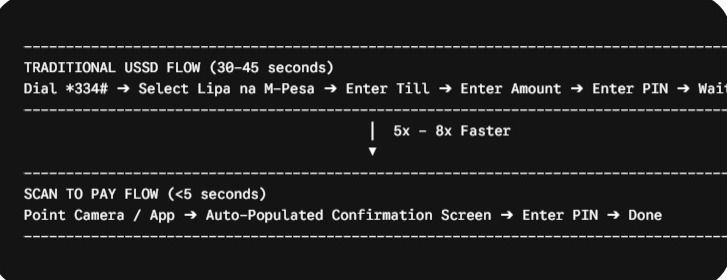
Scan-to-Pay bypasses manual input. By encoding merchant routing identifiers (and optionally transaction amounts) directly into a two-dimensional barcode, the camera captures the payload instantly, converting a complex multitouch process into a single authentication step.
2. The Regulatory Enabler: CBK’s KE-QR Standard
Prior to 2023, the Kenyan QR landscape was highly fragmented. Safaricom offered proprietary M-Pesa QR codes, while banks like Equity and Absa issued separate proprietary static codes. A merchant had to display multiple laminated cards at their counter, confusing buyers and forcing apps to lock out competing payment rails. In May 2023, the Central Bank of Kenya (CBK) issued the Kenya Quick Response Code Standard 2023 (KE-QR Standard).
Technical Foundation of KE-QR
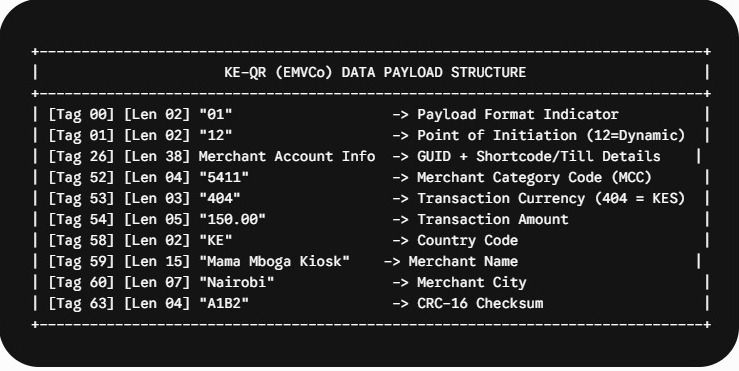
The KE-QR standard is built on top of the EMV® QR Code Specification for Payment Systems (Merchant-Presented Mode). This means every payment QR code issued in Kenya must adhere to a standardized Tag-Length-Value (TLV) structure.
Strategic Impact for Developers
Interoperability means fintech startups no longer need to build closed-loop payment networks. A developer can build a specialized merchant app or hardware device, issue a compliant KE-QR code, and accept payments originating from:
- M-Pesa App / MySafaricom App
- Bank Applications (Equity Mobile, NCBA Loop, Absa Kenya, KCB)
- International Payment Apps compliant with EMVCo standards
3. High-Yield Verticals for Developer Ventures
| Vertical | Current Pain Point | Scan-to-Pay Solution Strategy | Monetization Model |
| Public Transit (Matatus) | Conductor cannot verify payments during movement; cash theft by crews. | Seatback Static KE-QR codes + Smart Speaker for conductor audio verification. | KES 1–3 flat fee per fare collection; subscription for fleet analytics. |
| Micro-Retail (Mama Mboga / Stalls) | High transaction volume, small amounts (KES 20–200), manual entry bottlenecks. | Low-cost dynamic display screen or dynamic QR generated via lightweight mobile app. | Micro-SaaS monthly fee (KES 300–500/mo) for inventory & payment aggregation. |
| Nightlife & Open-Air Markets | Dark environments, high risk of fake SMS notification scams. | Illuminated / E-paper display with real-time audio chime upon confirmation. | Hardware sale margin + SaaS fee for daily revenue reconciliation. |