How to Mix Hydroponic Nutrients: A Guide to pH & EC Management in Kenya
How to Mix Hydroponic Nutrients: A Guide to pH & EC Management in Kenya
In traditional farming, soil acts as a buffer, storing minerals, balancing moisture, and forgiving minor fertilization mistakes. In hydroponics, that safety net is gone. You assume complete responsibility for your crop’s digestive system.
Delivering water without balanced nutrients will starve your plants, while using standard granular soil fertilizers like DAP or CAN will quickly clog pumps, lock out root uptake, and destroy your crop.
To run a successful hydroponic farm in Kenya, you must master two fundamental disciplines:
formulating/mixing water-soluble hydroponic nutrients and managing pH and Electrical Conductivity (EC).
1. Why Soil Fertilizers Fail in Hydroponics
Standard agricultural fertilizers used in Kenyan fields are formulated for microbial breakdown in soil and are ill-suited for hydroponic systems:
- Lack of Complete Micronutrients: Soil fertilizers assume the earth already provides calcium, magnesium, iron, boron, and zinc. Hydroponic plants depend on you for 100% of these 12 essential mineral elements.
- Insoluble Fillers & Aggressive N Forms: Soil NPKs contain high levels of urea or ammonium that cause toxic pH spikes in water and leave insoluble residues that clog drip emitters and pump impellers.
- Precipitation (Chemical Reaction): Concentrated calcium mixed directly with sulfates or phosphates creates gypsum (calcium sulfate), an insoluble chalky sludge that strips nutrients out of the water.
2. The Golden Rule: Concentrated Stock Tanks A & B
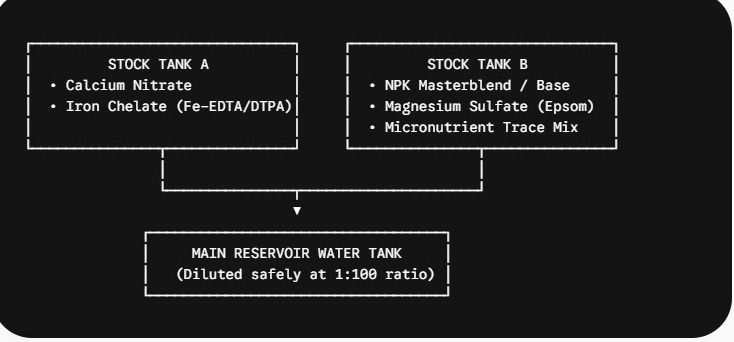
To prevent chemical precipitation, professional hydroponic formulations are split into two separate concentrated stock tanks, Tank A and Tank B:
- Tank A holds Calcium Nitrate and Iron Chelates.
- Tank B holds NPK, Magnesium Sulfate (Epsom Salt), and trace micronutrients (Boron, Zinc, Manganese, Copper, Molybdenum).
Crucial Rule: Never mix concentrated Stock A and Stock B together directly in dry or raw liquid form. They must only meet inside the main water reservoir after being fully diluted.
3. Step-by-Step Guide: Mixing a 1,000-Liter Reservoir
For a standard 1,000-Liter working reservoir (e.g., growing leafy greens or herbs), follow this step-by-step mixing sequence:
1.Analyze and Prepare Your Base Water:
Baseline water check avoids over-dosing.
Fill your reservoir tank with clean water. If using municipal tap water (e.g., Nairobi Water), let it sit open for 24 hours to dissipate chlorine. Test the baseline Electrical Conductivity (EC) and pH using digital meters. Ideal raw baseline water should have an EC below 0.4 mS/cm.
2.Add Concentrated Stock A Solution:
Stir until completely dissolved into clear liquid.
Measure out your pre-mixed Stock A concentrate (Calcium Nitrate base). Pour Stock A into the main reservoir and stir thoroughly using a clean mixing rod or run your submersible pump for 5 minutes to distribute.
3.Add Concentrated Stock B Solution:
Never add Stock B until Stock A is thoroughly diluted.
Pour the equal measure of Stock B concentrate into the reservoir. Stir or circulate the water vigorously. The dissolved calcium and sulfates now mix safely without forming precipitates.
4.Measure and Calibrate Electrical Conductivity (EC):
Target EC ranges vary by crop type.
Dip your digital EC meter into the reservoir. For lettuce/herbs, target 1.2 to 1.6 mS/cm. For tomatoes/peppers, target 2.0 to 2.5 mS/cm. If EC is too low, add equal micro-doses of Stock A & B. If EC is too high, dilute by adding plain water.
5.Calibrate Water pH (5.5 to 6.5 Range):
Final adjustment locks in nutrient availability.
Measure pH using your calibrated pH meter. If pH is above 6.5 (common with hard borehole water), add small increments of pH Down (phosphoric acid). Stir, wait 10 minutes, and re-test until the reading stabilizes between 5.8 and 6.2.
4. Understanding EC and pH Management
Electrical Conductivity (EC): Measuring Fertilizer Strength
EC measures the electrical charge of dissolved mineral salts in water, expressed in mS/cm (milliSiemens per centimeter) or PPM (parts per million).
- Low EC (< 1.0 mS/cm): Plants are hungry, leading to pale foliage and slow growth.
- Optimal EC (1.2 – 2.4 mS/cm depending on crop): Balanced nutrient absorption and rapid growth.
- Excessive EC (> 3.0 mS/cm): Salt stress, leaf tip burn, and root dehydration (osmotic shock).
Water pH: The Key to Nutrient Uptake
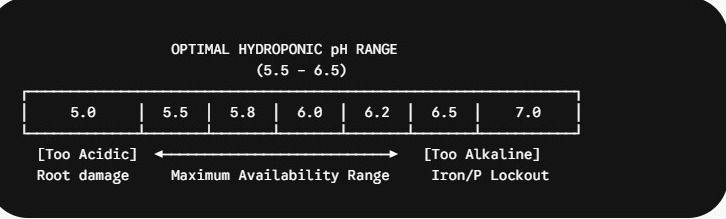
pH measures acidity or alkalinity on a 0–14 scale. Even if your water is filled with nutrients, plants cannot absorb them if the pH is out of range.
- If pH rises above 6.8, Iron, Manganese, and Phosphorus lock out, causing leaf yellowing (chlorosis).
- If pH drops below 5.0, Calcium and Magnesium uptake stops, damaging roots.
5. Target pH & EC Reference Guide for Common Crops
| Crop Type | Growth Stage | Target EC Range (mS/cm) | Target pH Range |
| Lettuce & Leafy Greens | Vegetative to Harvest | 1.2 – 1.6 | 5.6 – 6.2 |
| Culinary Herbs (Basil, Dania) | Continuous Harvest | 1.4 – 1.8 | 5.8 – 6.2 |
| Strawberries | Flowering & Fruiting | 1.8 – 2.2 | 5.5 – 6.0 |
| Tomatoes & Capsicums | Vegetative | 1.6 – 2.0 | 5.8 – 6.5 |
| Tomatoes & Capsicums | Heavy Fruiting Peak | 2.2 – 2.8 | 5.8 – 6.2 |
| Hydroponic Fodder | 7-Day Cycle | Plain Water (0.4 - 0.8) | 6.0 – 6.8 |
6. Local Water Quality Challenges in Kenya
- Hard Borehole Water (Rift Valley, Kajiado, Coastal Regions): Borehole water in these areas often contains high baseline levels of dissolved calcium carbonates, iron, and fluorides, elevating raw EC above 1.0 mS/cm before adding any fertilizer.
- Solution: Test raw water before buying nutrients. High-alkalinity water requires higher doses of pH Down (Phosphoric Acid) to keep pH stable.
- Algae Growth in Tanks: Warm weather in Kenya encourages rapid algae blooms inside transparent water tanks. Algae consumes nutrients and swings pH wildly overnight.
- Solution: Always use dark, light-proof water tanks (black/dark blue Roto tanks) and keep reservoir lids tightly sealed.