Is Hydroponics Profitable in Kenya? Setup Costs, ROI & Minimum Space
Is Hydroponics Profitable in Kenya? Setup Costs, ROI & Minimum Space
The financial viability of hydroponics in Kenyais often surrounded by two extremes: skeptics who call it a high-tech money pit, and enthusiasts who promise instant riches. The reality lies in clear numbers, strict operational discipline, and market alignment.
With land prices in peri-urban areas like Kiambu, Machakos, and Kajiado soaring, traditional soil farming on small plots yields diminishing returns. Hydroponics allows growers to build high-density, vertical, or high-throughput commercial units that yield 3x to 5x more crop volume per square meter than traditional open-field farming while cutting water usage by 80% to 90%.
This article presents an unvarnished financial breakdown of commercial hydroponics in Kenya, covering startup costs, operating expenses, spatial thresholds, and realistic Return on Investment (ROI) timelines.
1. What is the Minimum Space Required for Commercial Hydroponics?
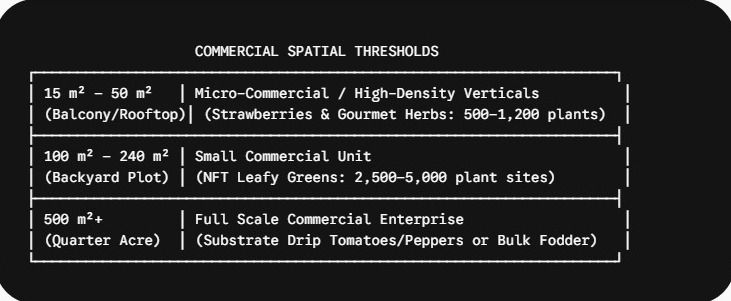
Space requirements depend heavily on your target crop and business model. Hydroponics is not one-size-fits-all; spatial footprints scale according to commercial intent.
- Micro-Commercial Tier (15 m² to 50 m²):
- Best Crops: Strawberries in vertical towers, gourmet culinary basil, and specialty herbs.
- Capacity: Accommodates 500 to 1,200 plant sites using vertical A-frames or vertical pipe columns.
- Commercial Goal: Direct-to-consumer sales, estate subscription boxes, or supplying 2 to 4 local boutique restaurants.
- Small Commercial Unit (100 m² to 240 m² / Approx. 1/8th Acre):
- Best Crops: Butterhead/Romaine lettuce, spinach, kale, and celery.
- Capacity: Fits an 8m × 15m or 8m × 30m shadehouse running NFT channels with 2,500 to 5,000 active plant sites.
- Commercial Goal: Weekly contract supply to greengrocers, supermarket branches (e.g., Naivas, Carrefour), and hotel kitchens.
- Full Commercial Enterprise (500 m² to 1,000 m² / Approx. Quarter Acre+):
- Best Crops: Indeterminate tomatoes, colored bell peppers, English cucumbers, or 100 kg/day animal fodder units.
- Capacity: Multi-span greenhouses using Dutch bucket substrate drip lines or continuous fodder sprouting racks.
- Commercial Goal: Wholesale regional produce supply, hotel chains, and food processing hubs.
2. Startup Cost Breakdown (CAPEX in KES)
Initial capital expenditures (CAPEX) depend on your construction material choices (wooden vs. steel frame) and level of automation. Below are standard investment budgets for three common commercial entry points:
| Infrastructure Item / Scale | Micro Unit (30 m²) | Small Commercial (100 m²) | Standard Commercial (240 m²) |
| Structure Frame & Cover | KES 25,000 (Shade net) | KES 140,000 (Wooden frame + UV) | KES 270,000 (Galvanized steel) |
| Hydroponic Piping / Channels | KES 20,000 (DIY PVC lines) | KES 110,000 (NFT Gullies/Pipes) | KES 210,000 (Commercial NFT/Buckets) |
| Reservoirs, Pumps & Plumbing | KES 12,000 (500L Tank + pump) | KES 45,000 (1000L Tank + heavy pump) | KES 85,000 (Dual 2000L + solar pump) |
| Meters & Monitoring Kit | KES 5,000 (Basic pH/EC tools) | KES 12,000 (Digital EC & pH meters) | KES 25,000 (Continuous monitors) |
| Initial Seeds, Media & Nutrients | KES 8,000 (Stock A/B + starter) | KES 25,000 (Bulk Stock A/B + Cocopeat) | KES 50,000 (Bulk ingredients + media) |
| TOTAL STARTUP INVESTMENT | KES 70,000 – KES 95,000 | KES 332,000 – KES 380,000 | KES 640,000 – KES 780,000 |
3. Financial Model: 100 m² NFT Lettuce Unit (1-Year Income Statement)
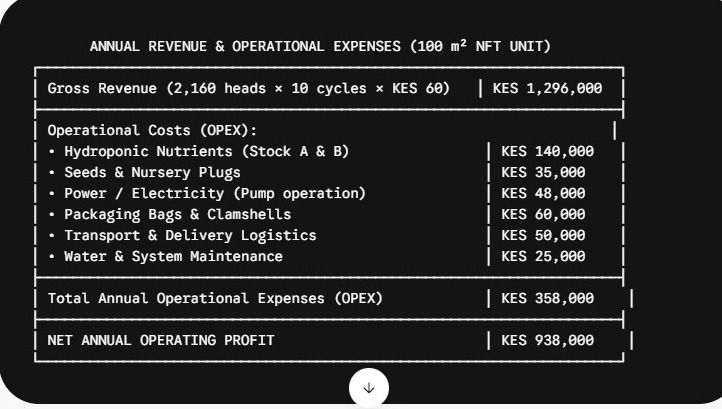
To demonstrate commercial feasibility, let's examine a real-world financial projection for a 100 m² NFT setup growing high-value Butterhead Lettuce for peri-urban markets.
Operational Parameters
- Plant Capacity: 2,400 active plant holes in NFT channels.
- Crop Cycle: 35 days from transplanting to harvest (approx. 10 harvest cycles per year).
- Loss / Mortality Buffer: 10% (calculating revenue on 2,160 marketable heads per cycle).
- Average Market Wholesale Price: KES 60 per head (supplying greengrocers & estate clients).
Annual Cash Flow Statement (KES)
ROI & Payback Calculation

4. Top Operational Risks & Mitigation Strategies
While the margins are attractive, commercial hydroponic farms can fail if operational risks are unmanaged. Below are the three main operational pitfalls in Kenya and how to address them:
Risk 1: Unannounced Power Outages (Kenya Power Interruption)
In NFT systems, a prolonged power loss stops water pumps, causing bare plant roots inside hot PVC channels to dry out and die within 45 to 60 minutes.
- Mitigation Strategy: Install a small 12V DC solar-powered pump backup or operate a hybrid Deep Water Culture (DWC) system where roots remain submerged in oxygenated nutrient liquid during power losses.
Risk 2: Hard Water & High Baseline EC
Using untreated, high-alkalinity borehole water (common in Kajiado, Naivasha, and Coastal regions) locks out nutrient uptake, damages plant roots, and causes severe nutrient deficiencies.
- Mitigation Strategy: Conduct a comprehensive water test before building your system. If raw baseline water EC exceeds 0.8 mS/cm, install a reverse osmosis (RO) filter or collect and store roof rainwater in large storage tanks.
Risk 3: Market Gluts & Single-Buyer Dependency
Relying entirely on a single buyer or wholesale market leaves you vulnerable to sudden price drops or canceled orders.
- Mitigation Strategy: Diversify your sales across three distinct market tiers: 50% under contract to supermarkets/restaurants, 30% to local greengrocers, and 20% reserved for direct-to-consumer estate deliveries.
5. Summary Checklist: Transitioning from Beginner to Commercial Hydroponic Farmer
- Conduct a Market Audit First: Secure verbal or written supply interest from local hotels, restaurants, or estate delivery groups before buying construction materials.
- Match System to Budget & Location: Build DWC or Substrate Drip systems if power is unreliable or temperatures are extremely high. Build NFT channels for high-density leafy green production.
- Master Nutrients Early: Purchase digital EC and pH meters on day one. Never guess fertilizer dosages; calibrate your water reservoir daily.
- Scale Incrementally: Start with a 30 m² to 100 m² proof-of-concept unit to refine your growing protocol, seed nursery management, and sales routes before expanding to full commercial acreage.